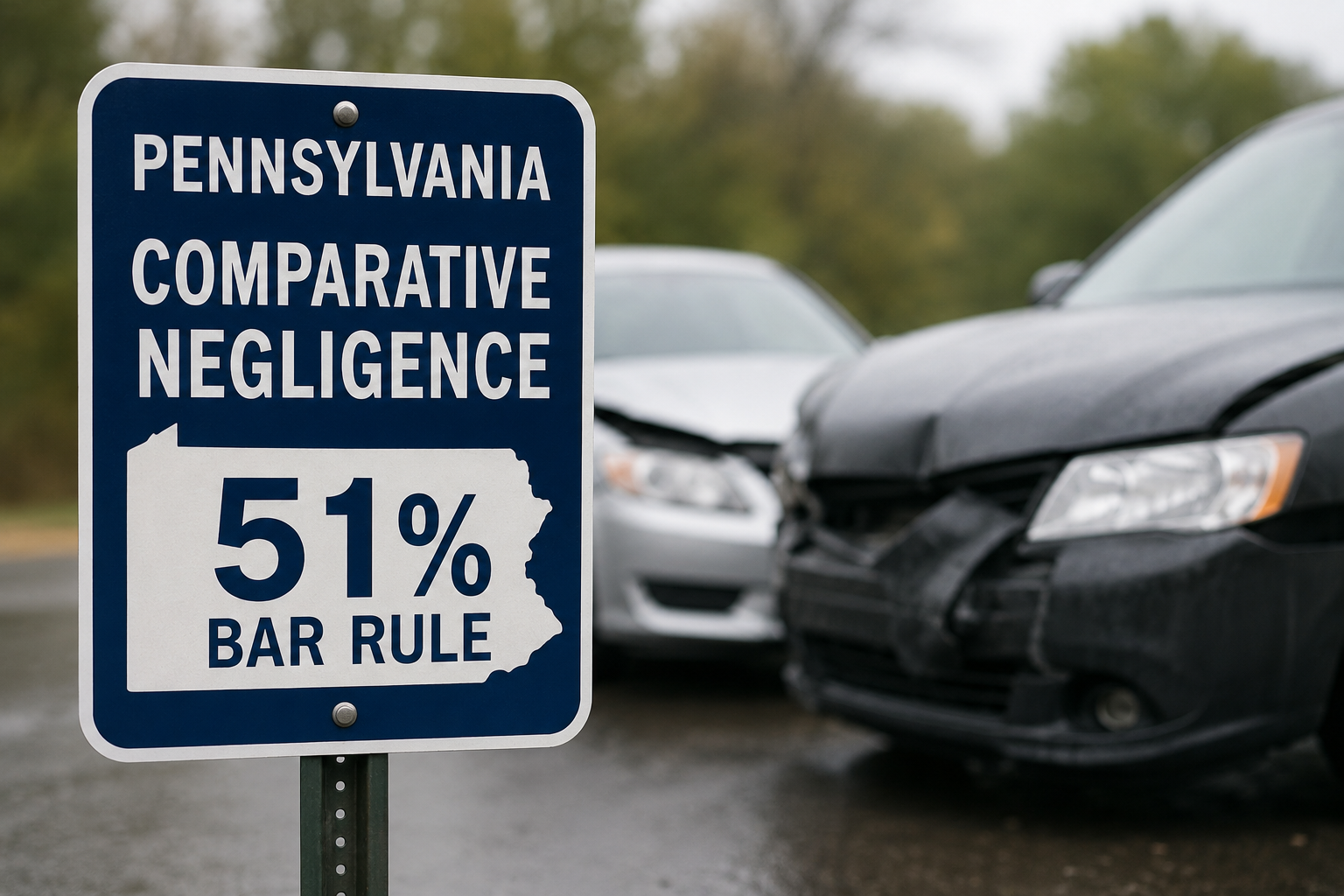
Partially at Fault in Pennsylvania? Here's What Accident Victims Need to Know
Being injured in an accident is overwhelming. Discovering you may share some of the blame makes it even harder. Pennsylvania's fault rules are nuanced and misunderstanding them could cost you significant compensation.
- Pennsylvania follows a modified comparative negligence system
- Your recovery is reduced by your percentage of fault
- Exceed a specific fault threshold and you lose your right to recover entirely
- The right attorney can mean the difference between full compensation and nothing
This guide explains exactly how Pennsylvania's fault laws work, what evidence matters most, and how platforms like INIH Solutions LLC help injured people find qualified attorneys who fight for every dollar they deserve.
Disclaimer: INIH Solutions LLC is a referral service connecting you with personal injury attorneys. Submitting information does not create an attorney-client relationship and is not legal advice.
Pennsylvania's Modified Comparative Negligence Rule Explained
Pennsylvania uses a legal doctrine called modified comparative negligence meaning injured parties can still recover damages even if they contributed to the accident, up to a defined limit.
- Your compensation is reduced proportionally by your share of fault
- If you are found 51% or more at fault, you are completely barred from recovery
- This rule applies to car accidents, slip and falls, and most personal injury claims
- Insurance adjusters use this rule aggressively to minimize payouts
Understanding where the 51% threshold sits is critical. A single percentage point above it eliminates your entire claim. That is why legal representation matters enormously from the very first conversation.
What Is the 51% Bar Rule in Pennsylvania?
The 51% bar rule means that if a jury or adjuster determines you were 51% or more responsible for your own injury, Pennsylvania law completely bars you from collecting any compensation even from a party who was also negligent.
- Pennsylvania Consolidated Statutes Title 42, Section 7102 codifies this rule
- Fault is determined by evidence: police reports, witness statements, and expert analysis
- Insurance companies often inflate your fault percentage deliberately to reduce or deny claims
- An experienced attorney can challenge inflated fault assignments with counter-evidence
How Does Comparative Fault Reduce Your Compensation?
The reduction is direct and mathematical. If you suffered $100,000 in damages but were found 30% at fault, your recoverable compensation drops to $70,000. The at-fault party's insurance only pays for their share of responsibility.
- Medical bills, lost wages, and pain and suffering are all subject to reduction
- Future damages ongoing treatment, lost earning capacity are also reduced
- Non-economic damages like emotional distress follow the same proportional formula
- Wrongful death claims in Pennsylvania are also governed by comparative fault rules
| Your Fault % | Total Damages | Recoverable Amount | Outcome |
|---|---|---|---|
| 0% | $100,000 | $100,000 | Full recovery |
| 20% | $100,000 | $80,000 | Reduced recovery |
| 40% | $100,000 | $60,000 | Reduced recovery |
| 50% | $100,000 | $50,000 | Still recoverable |
| 51% | $100,000 | $0 | Barred from recovery |
| 75% | $100,000 | $0 | Barred from recovery |
Pennsylvania's Two Insurance Systems: Limited Tort vs. Full Tort
Pennsylvania is one of the few states offering drivers a choice between two tort systems when purchasing auto insurance. This choice dramatically affects what you can claim after an accident especially when fault is shared.
- Full Tort: Preserves your unlimited right to sue for pain and suffering after any accident
- Limited Tort: Restricts your right to sue for non-economic damages unless injuries meet a defined "serious injury" threshold
- Most drivers choose limited tort because premiums are lower without realizing the trade-off
- Exceptions to limited tort exist: DUI drivers, out-of-state vehicles, intentional acts
Does Limited Tort Affect Partial Fault Cases?
Yes significantly. If you carry limited tort coverage and share fault for an accident, your recovery barriers are compounded. You face both the comparative fault reduction and the serious injury threshold requirement simultaneously.
- A serious injury under Pennsylvania law typically means death, serious impairment of bodily function, or permanent disfigurement
- Soft tissue injuries, whiplash, and minor fractures often fail to meet this threshold under limited tort
- An attorney can evaluate whether your injuries qualify for an exception this analysis is critical
- Switching from limited to full tort is not retroactive; your coverage at the time of the accident governs
| Coverage Type | Pain & Suffering Claims | Fault Threshold Applies? | Best For |
|---|---|---|---|
| Full Tort | Unrestricted | Yes (51% bar) | Maximum legal protection |
| Limited Tort | Restricted (serious injury only) | Yes (51% bar + injury threshold) | Lower premiums, higher risk |
Common Accident Types Where Shared Fault Arises in Pennsylvania
Shared fault is not limited to one type of accident. Across Pennsylvania's 6.14 million annual crashes generating over 2.44 million injuries, partial fault disputes are extremely common in several specific scenarios.
- Rear-end collisions: Even the rear driver can argue the front driver stopped suddenly or had broken brake lights
- Left-turn accidents: The turning driver is usually presumed at fault, but oncoming speeding can shift responsibility
- Pedestrian accidents: Jaywalking or distracted walking can reduce pedestrian recovery
- Slip and fall cases: Property owners argue victims were inattentive or ignored warning signs
- Bicycle accidents: Lane position and signal compliance affect fault allocation
How Do Insurers Determine Fault Percentages?
Insurance companies use internal fault assessment algorithms, police reports, and adjuster interviews to assign fault percentages. These assessments are not final and are often strategically inflated against claimants.
- Adjusters review the official police accident report as the baseline document
- Witness credibility assessments heavily influence adjuster conclusions
- Surveillance footage, dashcam video, and cell phone data are increasingly used
- Accident reconstruction experts can challenge insurer fault determinations in litigation
- Research shows 40–65% of insurer first offers fall below fair value partial fault is a key tool to justify lowball offers
The Real Financial Stakes: What Pennsylvania PI Cases Are Worth
Pennsylvania personal injury cases involve real economic value. Understanding the financial stakes helps injured people recognize why fighting a fault assignment even a small one is worth the effort.
- The U.S. personal injury market reached $53.1 billion in 2023, with a 2.5% average annual growth rate
- Attorneys typically work on a 33% contingency fee meaning a $100,000 settlement generates $33,000 in attorney revenue
- A 20% fault assignment on a $200,000 claim eliminates $40,000 from your pocket
- Victims with attorneys recover 3.5x more than unrepresented claimants
What Is the Average Personal Injury Settlement in Pennsylvania?
Settlement values vary widely by injury severity, liability clarity, and insurance policy limits. However, motor vehicle accident cases in particular carry significant median values that make legal representation financially logical even after attorney fees.
- The median MVA case award in Florida was $1.2 million in 2022 Pennsylvania metro-area cases reflect similarly high values in serious injury matters
- Minor injury cases typically settle in the $15,000–$75,000 range
- Moderate injuries with surgery or hospitalization often reach $100,000–$500,000
- Severe or catastrophic injuries frequently exceed $1 million, particularly in trucking cases
- "Nuclear verdicts" exceeding $10 million have increased significantly in recent years, especially in commercial trucking cases
| Injury Severity | Typical Settlement Range | Timeline to Settlement | Fault Impact |
|---|---|---|---|
| Minor (soft tissue, whiplash) | $15,000 – $75,000 | 3–6 months | Even 10% = $1,500–$7,500 lost |
| Moderate (fractures, surgery) | $100,000 – $500,000 | 6–14 months | 10% = $10,000–$50,000 lost |
| Severe (TBI, spinal cord) | $500,000 – $2,000,000+ | 12–24 months | 10% = $50,000–$200,000 lost |
| Wrongful Death | $1,000,000+ | 12–36 months | Comparative fault fully applies |
Pennsylvania's Statute of Limitations: Do Not Miss This Deadline
A statute of limitations is the legally mandated deadline by which you must file a lawsuit. Miss it, and Pennsylvania courts will almost certainly dismiss your case regardless of how strong your evidence is or how serious your injuries are.
- Pennsylvania's general personal injury statute of limitations is two years from the date of the accident (42 Pa. C.S. § 5524)
- For minors, the clock typically starts on their 18th birthday, giving until age 20 to file
- Medical malpractice cases follow a two-year limit from discovery of the harm
- Government entity claims require a six-month notice of intent before the two-year period runs
- Wrongful death claims also carry a two-year deadline from the date of death
Are There Any Exceptions to Pennsylvania's Two-Year Deadline?
Yes limited exceptions exist, but they are narrow and difficult to invoke. The discovery rule tolls (pauses) the statute if an injury was not reasonably discoverable at the time of the accident. This is most common in medical malpractice, toxic exposure, and latent injury cases.
- Fraudulent concealment by a defendant can also toll the statute
- Mental incompetence at the time of injury may pause the clock
- These exceptions require specific legal arguments they are not automatic
- Never assume an exception applies without consulting an attorney first
| Claim Type | Filing Deadline | Special Rules |
|---|---|---|
| Personal Injury (General) | 2 years from incident | Discovery rule may apply |
| Wrongful Death | 2 years from date of death | Survival action separate |
| Minor Injury Claims | Age 18 + 2 years | Parents can file earlier |
| Government Entity Claims | 6-month notice + 2 years | Strict notice requirements |
| Medical Malpractice | 2 years from discovery | 7-year absolute deadline |
Evidence That Determines Fault Allocation in Pennsylvania Accidents
In shared-fault cases, evidence is everything. The party with stronger documentation almost always receives a lower fault assignment and a higher recovery. Building your evidence file starts at the accident scene.
- Police accident report: The baseline document adjusters and attorneys rely on first
- Photographs and video: Scene, vehicle damage, road conditions, traffic signals, and visible injuries
- Witness statements: Independent bystanders carry significant credibility with insurers and juries
- Medical records: Document every symptom from day one gaps in treatment are used against claimants
- Surveillance and dashcam footage: Must be preserved immediately; many systems overwrite within 24–72 hours
- Expert witnesses: Accident reconstructionists can scientifically rebut insurer fault assignments
Why Does Speed of Response Matter After a Pennsylvania Accident?
Evidence deteriorates rapidly. Skid marks fade, witnesses forget details, and surveillance footage gets overwritten. Research shows that leads contacted within 1 minute convert at 391% higher rates than those contacted after 30 minutes a data point that mirrors the urgency of evidence collection itself.
- Contact an attorney within 24–48 hours of your accident whenever possible
- Your attorney can issue spoliation letters to preserve electronic evidence and surveillance footage
- Black box (EDR) data from vehicles must be preserved via court order in many cases
- Social media posts after an accident are discoverable avoid posting anything about the incident
How Insurance Companies Exploit Shared Fault Against You
Pennsylvania insurance adjusters are trained negotiators whose primary goal is to minimize claim payouts. Shared fault is one of their most powerful tools and they deploy it systematically against unrepresented claimants.
- Adjusters record your initial statement and look for admissions that increase your fault percentage
- Phrases like "I didn't see them coming" or "I should have braked sooner" are used against you
- Delayed medical treatment is framed as evidence your injuries are not serious or accident-related
- Pre-existing conditions are used to argue injuries existed before the accident
- Legal directories like FindLaw lost all first-page visibility between 2023 and 2024 meaning many victims searching for help are reaching outdated, overpriced resources instead of qualified attorneys
Should You Give a Recorded Statement to the Other Driver's Insurer?
No. You are not legally required to give a recorded statement to the opposing party's insurer. Doing so without an attorney almost always hurts your case. The adjuster is not on your side the recording is a tool to find statements that reduce your recovery.
- Politely decline and state you will have your attorney respond
- You must cooperate with your own insurer but retain counsel first if possible
- Never speculate about fault, speed, or what you saw in any statement
- Stick to verifiable facts only: date, time, location, and that injuries occurred
The Discovery Phase in Pennsylvania Personal Injury Litigation
The discovery phase is the formal pre-trial period during which both parties exchange evidence, take depositions, and develop their respective fault arguments. In shared-fault cases, discovery is where fault percentages are won or lost.
- Interrogatories: Written questions both parties must answer under oath
- Depositions: Recorded sworn testimony from all parties and key witnesses
- Requests for Production: Demands for documents, photos, medical records, and electronic data
- Independent Medical Examinations (IME): Defendant's insurer-selected doctor evaluates your injuries
- Expert disclosures: Both sides identify accident reconstructionists, medical experts, and vocational analysts
How Long Does the Discovery Phase Last in Pennsylvania?
Discovery timelines vary by court docket and case complexity. Pennsylvania local rules typically provide 180 days to 12 months for discovery in most personal injury cases, though complex multi-defendant or catastrophic injury cases can extend significantly longer.
- Philadelphia County has one of the most active civil dockets in Pennsylvania
- Allegheny County (Pittsburgh) courts follow similar timelines with local rule variations
- Cases with multiple defendants (e.g., distracted driver + road authority) extend discovery considerably
- Most PI cases 95–96% of them settle before trial, often during or after discovery
What a Personal Injury Attorney Actually Does in a Shared-Fault Case
Many accident victims assume attorneys simply file paperwork. In reality, a skilled Pennsylvania personal injury attorney plays an active, strategic role in minimizing your fault assignment and maximizing your recovery at every stage.
- Investigation: Attorneys immediately begin gathering evidence before it disappears
- Demand package: A comprehensive document presenting liability, damages, and legal authority to the insurer
- Fault rebuttal: Attorneys challenge insurer fault calculations with expert testimony and counter-evidence
- Negotiation: Experienced attorneys know insurer authority levels and push beyond initial offers
- Litigation: Filing suit creates leverage and forces insurers to take claims seriously
What Does a Contingency Fee Mean for Injured Pennsylvanians?
A contingency fee arrangement means your attorney receives no payment unless and until you recover compensation. The standard fee is typically 33% of the gross settlement or verdict. This structure eliminates financial barriers to quality legal representation for injured people of any income level.
- No upfront costs, no hourly bills, no retainer fees for most personal injury cases
- Case expenses (filing fees, expert costs, deposition costs) are advanced by the attorney and repaid from the settlement
- Contingency percentages may increase if a case proceeds to trial (often 40%)
- Always get the fee agreement in writing before signing a retainer
- A standard 33% contingency fee on a $50,000 settlement generates $8,250–$16,500 in attorney revenue meaning high-quality attorneys are economically motivated to fight for your maximum recovery
| Stage of Case | Typical Attorney Fee | Example: $200,000 Settlement |
|---|---|---|
| Pre-suit settlement | 33% | Attorney: $66,000 / Client: $134,000 |
| Post-suit, pre-trial | 33–40% | Attorney: $66,000–$80,000 / Client: $120,000–$134,000 |
| Trial verdict | 40% | Attorney: $80,000 / Client: $120,000 |
| Appeal | 40–45% | Negotiated separately |
Finding the Right Personal Injury Attorney for Your Pennsylvania Case
Not all personal injury attorneys have equal experience handling comparative fault cases. Choosing the right legal partner significantly impacts your outcome especially when shared fault is in dispute.
- Look for attorneys with specific Pennsylvania personal injury trial experience, not just settlement history
- Verify Pennsylvania bar membership and any disciplinary history via the Pennsylvania Bar Association
- Ask about their specific experience with comparative fault defense in cases similar to yours
- Request their track record in cases involving disputed fault percentages specifically
- Confirm they handle your case type: auto accidents, premises liability, trucking, etc.
How Does INIH Solutions LLC Help Injured Pennsylvanians Find the Right Attorney?
INIH Solutions LLC is a free referral service that connects injured people across Pennsylvania with qualified personal injury attorneys. The platform removes the guesswork and the anxiety from finding legal help after an accident.
- Free matching service with no obligation you choose which attorney to contact
- You are connected with local attorneys familiar with Pennsylvania's comparative fault rules
- Submitting your information through INIH does not create an attorney-client relationship
- The platform operates as a referral service not a law firm and does not provide legal advice
- You retain full control: you decide who represents you, and there is no pressure
If you have been injured in a Pennsylvania accident and are concerned about shared fault reducing your claim, contact INIH Solutions LLC today to be matched with a qualified personal injury attorney in your area free of charge and with no obligation.
Why Speed Matters When Choosing an Attorney After an Accident
The legal industry data is clear: delay costs injured people money. Across 1,000 law firms studied, the average firm misses 35% of inbound calls resulting in an average annual revenue loss of $250,000 per firm from missed and mishandled intake alone.
- Firms that answer quickly capture the best cases and serve clients better
- The sooner an attorney is engaged, the sooner evidence preservation begins
- Early attorney involvement prevents costly mistakes like giving recorded statements
- INIH Solutions LLC's matching platform helps ensure your inquiry reaches responsive, qualified attorneys without delay
Damages You Can Recover Even If You Are Partially at Fault
Even if Pennsylvania law reduces your recovery by your fault percentage, the total categories of damages available remain the same. A thorough damages calculation ensures your demand package reflects the full value of your claim before any reduction.
- Economic damages: Medical expenses (past and future), lost wages, lost earning capacity, property damage
- Non-economic damages: Pain and suffering, emotional distress, loss of enjoyment of life, disfigurement
- Loss of consortium: Compensation for your spouse's loss of companionship and support
- Punitive damages: Available in cases of extreme recklessness or intentional misconduct (DUI, road rage)
How Is Pain and Suffering Calculated in Pennsylvania?
Pennsylvania does not cap pain and suffering damages in most personal injury cases. Attorneys typically use one of two calculation methods: the multiplier method (economic damages × 1.5 to 5) or the per diem method (a daily rate for each day of suffering).
- Severe injuries with permanent disability typically use higher multipliers (3–5x)
- Minor temporary injuries typically use lower multipliers (1.5–2.5x)
- Documentation of daily impact pain journals, medical records, therapy notes strengthens these calculations
- Your attorney selects the method most favorable to your specific injury profile
| Damage Category | Calculation Method | Example Value | Subject to Fault Reduction? |
|---|---|---|---|
| Medical Expenses | Actual bills + future projections | $30,000 | Yes |
| Lost Wages | Pay stubs + employer verification | $20,000 | Yes |
| Pain & Suffering | Multiplier or per diem | $50,000–$150,000 | Yes |
| Loss of Consortium | Spousal impact assessment | $10,000–$50,000 | Yes |
| Punitive Damages | Jury discretion | Varies widely | Not always reduced |
Special Situations: Multi-Defendant Cases and Joint Liability in Pennsylvania
Some Pennsylvania accidents involve more than one at-fault party. A distracted driver in a construction zone, a defective vehicle part, or a poorly maintained road can add multiple defendants to a single claim each with their own fault allocation.
- Pennsylvania follows a modified joint and several liability rule under Act 1 of 2002
- Defendants found 60% or more liable are jointly and severally responsible for all economic damages
- Defendants below 60% fault are only responsible for their proportionate share of economic damages
- Non-economic damages are always proportionate regardless of defendant fault percentages
What Happens If One Defendant Cannot Pay Their Share?
When a defendant is judgment-proof (no assets, no insurance), recovery of their share may be impossible. This is where the joint and several liability rule becomes critical defendants above the 60% threshold must cover the gap for insolvent co-defendants on economic damages.
- Uninsured/Underinsured Motorist (UM/UIM) coverage on your own policy can fill gaps left by insolvent defendants
- Pennsylvania requires insurers to offer UM/UIM coverage though drivers can waive it in writing
- Umbrella policies held by defendants can increase available recovery in serious injury cases
- An attorney identifies all potential sources of recovery not just the primary defendant
Pennsylvania Trucking Accidents and Comparative Fault: Higher Stakes, More Complexity
Commercial trucking accidents in Pennsylvania involve federal regulations, multiple potentially liable parties, and insurance policies with significantly higher limits than standard auto cases. Fault allocation in these cases is intensely contested.
- Federal Motor Carrier Safety Administration (FMCSA) regulations govern driver hours, vehicle maintenance, and cargo loading
- Potentially liable parties include: the driver, trucking company, cargo loader, vehicle manufacturer, and maintenance contractor
- Commercial trucking insurers carry policies from $750,000 to $5 million+ making aggressive fault defense common
- Electronic logging device (ELD) data, GPS records, and maintenance logs are critical evidence in trucking cases
- Nuclear verdicts in trucking cases have increased significantly in recent years due to jury outrage at unsafe practices
Steps to Take Immediately After a Pennsylvania Accident
Your actions in the minutes and hours after an accident directly affect your comparative fault assignment. A structured, documented response protects your legal rights from the very first moment.
- Step 1: Call 911 ensure a police report is filed; this is your foundational fault document
- Step 2: Seek medical attention immediately even if you feel fine; adrenaline masks injury symptoms
- Step 3: Document everything photographs of all vehicles, road conditions, traffic signals, and your visible injuries
- Step 4: Collect witness contact information independent witnesses are invaluable in disputed fault cases
- Step 5: Do not admit fault to anyone, including other drivers, bystanders, or police (state facts only)
- Step 6: Notify your insurance company but do not give a detailed recorded statement without counsel
- Step 7: Contact a personal injury attorney ideally within 24 hours
| Timeline | Action Required | Why It Matters |
|---|---|---|
| Immediately | Call 911, seek medical help | Creates official record; protects health |
| Within 1 hour | Document scene, collect witnesses | Evidence disappears rapidly |
| Within 24 hours | Contact an attorney | Preserves evidence via legal channels |
| Within 72 hours | Follow up with doctor | Closes gaps insurers exploit |
| Within 6 months | Evaluate settlement offers with counsel | Avoids accepting lowball offers |
| Before 2 years | File lawsuit if needed | Preserves legal rights under statute of limitations |
Marketing and Legal Industry Context: Why Attorney Quality Varies So Much
Not all attorneys invest equally in their practice or their clients. Understanding the legal marketing landscape helps accident victims make smarter choices when selecting representation.
- High-growth law firms spend an average of 16.5% of revenue on marketing, compared to just 5% for firms that saw no growth
- Higher marketing investment typically reflects both business sophistication and client service infrastructure
- Firms using AI-assisted intake workflows converted 41% more qualified leads into signed retainer agreements compared to firms using traditional intake processes
- AI bidding and media tools are reducing wasted paid media spend by an average of 29% for PI firms resources reinvested into better client outcomes
INIH Solutions LLC's matching platform connects injured people with attorneys who have demonstrated responsiveness, qualification, and local expertise cutting through the noise of an increasingly complex legal marketing landscape.
Frequently Asked Questions
Can I recover damages if I was more than 50% at fault in Pennsylvania?
No. Pennsylvania's 51% bar rule means that if you are found 50% or less at fault, you can recover damages proportionally reduced by your fault percentage. At exactly 51% or higher, you are completely barred from recovery under 42 Pa. C.S. § 7102.
- This makes precise fault determination critically important even 1% can mean the difference between recovery and nothing
- Insurance companies routinely attempt to push claimants above 51% through aggressive fault assignments
- An experienced attorney challenges these assignments with evidence and expert analysis
Does Pennsylvania require me to use my own insurance first after an accident?
Pennsylvania is a choice no-fault state. Drivers with limited tort coverage typically use their own Personal Injury Protection (PIP) benefits first. Full tort drivers can proceed directly against the at-fault party's liability insurance. Your coverage selection determines your initial claims pathway.
- PIP covers medical expenses regardless of fault up to policy limits
- PIP does not cover lost wages above a limited amount without wage loss coverage endorsement
- Exhausting PIP before pursuing the at-fault party is common in minor injury cases
What if the police report assigns fault to me incorrectly?
Police reports are influential but not legally binding on fault determination. You can challenge an incorrect fault finding with your own evidence, witness statements, and expert testimony. An attorney can formally dispute the report during the claims or litigation process.
- Request a copy of the report within days of the accident to review for errors
- Officers can supplement or amend reports when new evidence is presented
- Accident reconstruction experts carry significant weight against adverse police conclusions
How long do I have to file a personal injury claim in Pennsylvania?
Pennsylvania's personal injury statute of limitations is two years from the date of the accident. Missing this deadline almost always results in permanent loss of your right to sue regardless of how serious your injuries are or how clear the other party's fault may be.
- Government entity claims require a six-month notice filing before the two-year period
- Minor victims have until their 20th birthday to file in most circumstances
- Always consult an attorney well before the deadline do not wait until the final weeks
Should I accept the insurance company's first settlement offer?
Almost never. First offers from insurance companies are routinely 40–65% below fair value. Accepting immediately waives all future claims including for injuries that worsen over time or complications that emerge after settlement.
- Once you sign a release, your claim is permanently resolved regardless of future developments
- Attorneys can evaluate whether an offer reflects full value or leaves significant recovery on the table
- Never sign any release without having an attorney review it first
Is INIH Solutions LLC a law firm?
No. INIH Solutions LLC is a referral service not a law firm. It connects injured people with qualified personal injury attorneys in their area. Submitting your information through INIH does not create an attorney-client relationship and does not constitute legal advice. You choose which attorney you wish to work with, and there is no obligation to hire anyone.
- The service is free for injured people to use
- You retain complete control over which attorney, if any, you engage
- INIH connects you with licensed attorneys in Pennsylvania familiar with state-specific comparative fault rules
Key Takeaways for Pennsylvania Accident Victims
Pennsylvania's comparative negligence rules are complex, but they do not prevent injured people from recovering fair compensation as long as they act quickly, gather evidence, and work with qualified legal counsel.
- The 51% fault threshold is a hard bar staying below it is critical and contestable with strong evidence
- Your compensation is reduced proportionally by your fault percentage every percentage point has real dollar value
- Insurance companies systematically inflate fault assignments against unrepresented claimants
- Pennsylvania's two-year statute of limitations is unforgiving delay has permanent consequences
- Victims represented by attorneys recover 3.5 times more than those who handle claims alone
- INIH Solutions LLC provides a free, no-obligation way to connect with qualified Pennsylvania personal injury attorneys giving every injured person access to the legal help they deserve
If you or a loved one has been injured in a Pennsylvania accident regardless of whether you believe you were partially at fault the smartest first step is speaking with a qualified personal injury attorney. Evidence preservation, fault analysis, and legal strategy all begin on day one.
INIH Solutions LLC is a referral service. Submitting information does not create an attorney-client relationship. This content is not legal advice. Results vary depending on case facts and circumstances.