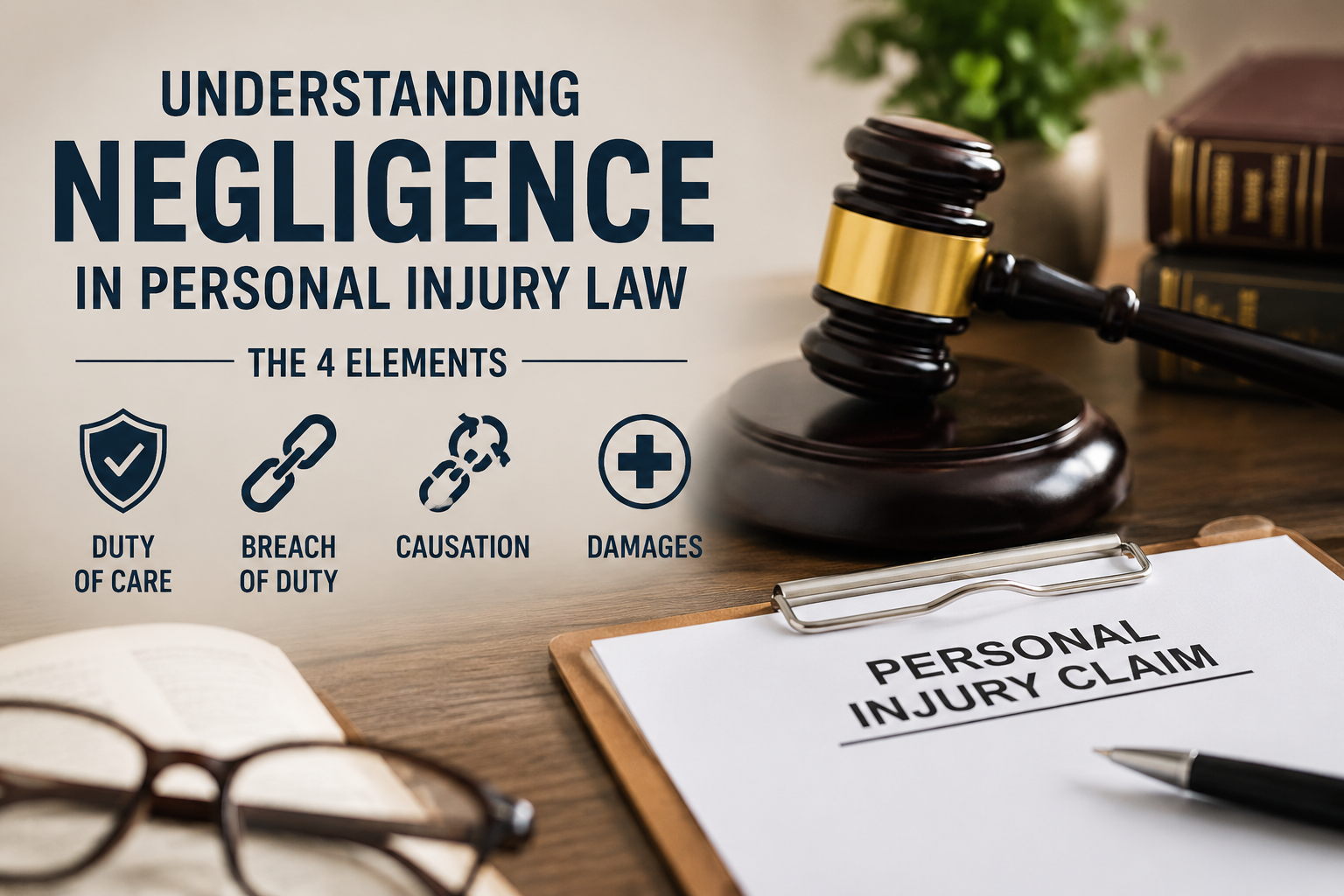
Personal Injury Negligence Explained: Duty, Breach, Causation, and Damages
Every personal injury claim rests on one legal foundation: negligence. Understanding how courts evaluate duty, breach, causation, and damages is the difference between a claim that settles and one that collapses. This guide breaks down every element with real data and practical clarity.
- Negligence is a four-part legal test applied in virtually every personal injury case
- Missing even one element can invalidate an otherwise strong claim
- The US personal injury market surpassed $53 billion in 2026, underscoring how high the stakes are
- Working with the right attorney dramatically improves outcomes at every stage
This is not legal advice. INIH Solutions LLC is a referral service that connects injured individuals with licensed personal injury attorneys. Submitting information does not create an attorney-client relationship.
What Is Negligence in Personal Injury Law?
Negligence is a legal doctrine requiring proof that one party's careless conduct caused measurable harm to another. It is the cornerstone of tort law the body of civil law governing personal wrongs and governs the vast majority of injury claims filed in the United States.
- A tort is a civil wrong (not a criminal act) that causes harm, giving the injured party the right to sue for compensation
- Negligence differs from intentional torts (assault, fraud) because it involves carelessness, not deliberate wrongdoing
- Proving negligence requires satisfying all four elements duty, breach, causation, and damages
- Failing any single element means the claim fails, regardless of how severe the injuries are
| Element | Legal Question | Who Bears the Burden | Common Evidence Used |
|---|---|---|---|
| Duty | Did the defendant owe the plaintiff a duty of care? | Plaintiff | Statutes, prior case law, relationships |
| Breach | Did the defendant violate that duty? | Plaintiff | Expert testimony, surveillance, records |
| Causation | Did the breach directly cause the injury? | Plaintiff | Medical records, accident reconstruction |
| Damages | What measurable losses did the plaintiff suffer? | Plaintiff | Medical bills, wage records, expert opinion |
Element One: Duty of Care
Duty of care is the legal obligation one person owes another to act with reasonable caution. Courts examine whether a reasonable person in the defendant's position would have foreseen that their actions could cause harm to someone like the plaintiff.
- Drivers owe a duty of care to all other road users pedestrians, cyclists, and other drivers
- Property owners owe a duty to visitors based on visitor classification (invitee, licensee, or trespasser)
- Doctors owe a duty of care defined by the accepted standard of medical practice in their specialty
- Employers owe a duty to maintain safe working conditions under federal and state occupational safety statutes
How Do Courts Determine Whether a Duty Exists?
Courts use foreseeability as the primary test. If a reasonable person could predict that a specific action or inaction might injure someone, a duty likely exists. The relationship between the parties also plays a critical role in establishing duty.
- Foreseeability test: Could the defendant have anticipated that someone would be harmed?
- Relationship test: Does a special relationship (doctor-patient, employer-employee, carrier-passenger) impose heightened duties?
- Statutory duty: Has a law already codified the duty (e.g., traffic codes, building codes)?
- Public policy: Would imposing duty on defendants serve broader social interests in safety?
Common Duty of Care Scenarios in PI Cases
| Scenario | Defendant | Duty Owed | Legal Basis |
|---|---|---|---|
| Car accident | Driver | Drive safely, obey traffic laws | State vehicle codes |
| Slip and fall | Property owner | Maintain safe premises | Premises liability statutes |
| Medical malpractice | Physician | Meet accepted standard of care | Medical licensing standards |
| Dog bite | Pet owner | Prevent animal from harming others | State strict liability statutes |
| Product defect | Manufacturer | Produce safe, non-defective products | Products liability doctrine |
| Workplace injury | Employer | Provide safe working environment | OSHA regulations, workers' comp law |
Element Two: Breach of Duty
A breach occurs when a defendant fails to meet their duty of care. Courts measure breach against the "reasonable person standard" what a prudent, careful person would have done under identical circumstances. The standard is objective, not based on the defendant's personal intentions.
- Running a red light breaches a driver's duty to obey traffic signals
- Failing to mop a wet floor breaches a store owner's duty to maintain safe premises
- Prescribing the wrong medication breaches a physician's duty to meet the medical standard of care
- Evidence of breach includes eyewitness testimony, surveillance footage, police reports, and expert opinions
What Is the Reasonable Person Standard?
The reasonable person standard asks: what would a hypothetical, prudent person have done in the same situation? It is the most widely applied legal test in negligence law. Courts do not expect perfection only reasonable care under the circumstances.
- A driver in a school zone is held to a higher standard of caution than a driver on an empty highway
- A surgeon is measured against what a competent surgeon in that specialty would have done
- A property owner is measured against what a prudent owner would do to identify and fix hazards
- Children are measured against other children of similar age, experience, and intelligence
Types of Evidence Used to Prove Breach
| Evidence Type | Example | Strength | Common Case Types |
|---|---|---|---|
| Surveillance Video | Store camera showing wet floor with no warning sign | Very Strong | Slip and fall, premises liability |
| Police Reports | Officer's determination of fault at accident scene | Strong | Auto accidents, DUI crashes |
| Expert Testimony | Medical expert stating surgical deviation from standard | Very Strong | Medical malpractice, product defects |
| Maintenance Records | Missing elevator inspection logs | Moderate | Premises liability, workplace injury |
| Eyewitness Statements | Bystander confirming driver ran red light | Moderate | Auto accidents, pedestrian injuries |
| Black Box Data | Truck's event data recorder showing speed before crash | Very Strong | Commercial trucking, auto accidents |
Element Three: Causation
Causation is often the most hotly contested element in a personal injury case. Plaintiffs must prove two sub-elements: actual cause (also called "but-for" causation) and proximate cause (legal foreseeability). Both must be satisfied before damages can be awarded.
- Actual cause (but-for test): But for the defendant's breach, would the plaintiff have been injured? If yes, actual cause is absent
- Proximate cause: Was the plaintiff's injury a foreseeable result of the defendant's breach, or was it caused by an unrelated intervening event?
- Insurance companies routinely challenge causation by arguing pre-existing conditions caused the injuries
- Medical documentation gathered immediately after an accident is critical for establishing causation
What Is the Difference Between Actual and Proximate Cause?
Actual cause establishes a factual link between the breach and the injury. Proximate cause asks whether that link is legally close enough to justify holding the defendant responsible. Both must be proven one without the other is legally insufficient.
- Actual cause example: A driver runs a red light (breach). But for running the light, the collision would not have occurred (actual cause established)
- Proximate cause example: The collision causing whiplash is a foreseeable consequence of running a red light (proximate cause established)
- Broken proximate cause: If a bystander's unrelated explosion caused additional injury, that superseding cause may break the causal chain
- Courts use the "substantial factor" test in cases involving multiple defendants contributing to the same harm
How Do Pre-Existing Conditions Affect Causation?
Pre-existing conditions are one of the most common defenses insurance companies raise. However, the "eggshell plaintiff" doctrine protects injured parties. Defendants must take plaintiffs as they find them even if a pre-existing condition made the plaintiff more vulnerable to injury.
- If a defendant's negligence worsened a pre-existing back condition, they are still liable for the aggravation
- Medical records showing the plaintiff's pre-accident health baseline are essential evidence
- Independent medical examinations (IMEs) ordered by insurers frequently attempt to minimize causation
- An experienced attorney can counter IME findings with treating physician testimony and imaging evidence
Element Four: Damages
Damages are the measurable losses the plaintiff suffered as a direct result of the defendant's negligence. Without provable damages, there is no viable claim even if duty, breach, and causation are all established. Personal injury damages fall into two primary categories: economic and non-economic.
- Economic damages are calculable financial losses: medical bills, lost wages, rehabilitation costs, property damage
- Non-economic damages compensate for intangible harm: pain and suffering, emotional distress, loss of enjoyment of life, disfigurement
- Punitive damages are awarded in cases of extreme misconduct to punish defendants and deter future behavior they are not available in every state or every case type
- Some states cap non-economic or punitive damages knowing your state's limits is critical to case valuation
How Are Personal Injury Damages Calculated?
Economic damages are calculated by totaling all documented financial losses. Non-economic damages are calculated using either the multiplier method (multiplying economic damages by a factor of 1.5 to 5) or the per diem method (assigning a daily dollar value to pain and suffering).
- Multiplier method: $50,000 in medical bills × 3 (severity multiplier) = $150,000 in non-economic damages
- Per diem method: $200/day × 500 days of suffering = $100,000 in non-economic damages
- Severity of injury, recovery timeline, and impact on daily life all influence which method produces a stronger result
- Attorney representation statistically produces 3.5 times more recovery than self-representation
Types of Compensable Damages in Personal Injury Cases
| Damage Type | Category | Examples | Documentation Needed |
|---|---|---|---|
| Medical expenses | Economic | ER bills, surgery, physical therapy, medication | Bills, EOBs, treatment records |
| Lost wages | Economic | Missed workdays, reduced earning capacity | Pay stubs, employer letter, tax returns |
| Property damage | Economic | Vehicle repair or replacement costs | Repair estimates, receipts |
| Future medical costs | Economic | Ongoing surgery, long-term care, prosthetics | Life care planner, medical expert |
| Pain and suffering | Non-Economic | Chronic pain, trauma, anxiety, PTSD | Medical records, psychological evaluation |
| Loss of consortium | Non-Economic | Loss of companionship, intimacy after injury | Spouse testimony, mental health records |
| Punitive damages | Punitive | Drunk driving deaths, intentional corporate harm | Evidence of gross negligence or malice |
Comparative and Contributory Negligence: What Happens When You're Partly at Fault
Most states recognize that accidents involve shared fault. The legal system handles this through comparative negligence doctrines that reduce or eliminate a plaintiff's recovery based on their percentage of fault. Understanding which doctrine applies in your state is essential before filing a claim.
- Pure comparative negligence: A plaintiff can recover even if 99% at fault damages are simply reduced by their fault percentage (California, New York, Florida)
- Modified comparative negligence (50% bar): Recovery is barred if the plaintiff is 50% or more at fault (many Midwestern states)
- Modified comparative negligence (51% bar): Recovery is barred if the plaintiff is 51% or more at fault (most common rule in the US)
- Pure contributory negligence: Any fault by the plaintiff, even 1%, bars all recovery (Alabama, Maryland, North Carolina, Virginia, DC)
How Does Comparative Fault Affect Settlement Value?
In a comparative fault state, your percentage of fault is subtracted from your total damages award. This directly affects what insurers offer and what attorneys argue during negotiations. Establishing that the defendant bears the greater share of fault is a core litigation strategy.
- Example: A $50,000 settlement reduced by 20% fault yields a $40,000 net recovery for the injured driver
- Insurers routinely try to assign plaintiffs a higher fault percentage to reduce their payout obligations
- An attorney's job includes gathering evidence that minimizes the plaintiff's assigned fault percentage
- In contributory negligence states, even minor fault by the plaintiff can be used to deny all compensation
The Statute of Limitations: Time Limits That Can End Your Case
The statute of limitations is the legally mandated deadline for filing a personal injury lawsuit. Missing this deadline permanently bars a plaintiff from seeking compensation regardless of how strong the underlying negligence case is. Every state sets its own deadlines, and exceptions are narrow.
- Most states set a 2- to 3-year statute of limitations for personal injury claims
- Medical malpractice claims often have shorter windows sometimes as little as 1 year from discovery
- Claims against government entities may require a notice of claim within 60 to 180 days of the incident
- The "discovery rule" can toll (pause) the clock if the plaintiff did not and could not reasonably have discovered the injury immediately
| State | Personal Injury SOL | Medical Malpractice SOL | Government Claims Notice Period |
|---|---|---|---|
| California | 2 years | 3 years / 1 year from discovery | 6 months |
| New York | 3 years | 2.5 years | 90 days |
| Texas | 2 years | 2 years | 6 months |
| Florida | 2 years (as of 2023) | 2 years | 3 years |
| Pennsylvania | 2 years | 2 years | 6 months |
| Illinois | 2 years | 2 years | 1 year |
How Personal Injury Claims Resolve: Settlements vs. Trials
The vast majority of personal injury cases never reach a courtroom. Settlement negotiations between attorneys and insurance adjusters resolve most claims before trial. Understanding how this process works helps plaintiffs set realistic expectations and make informed decisions.
- 95 to 96% of personal injury cases settle before reaching trial
- Minor injury cases typically settle in 3 to 6 months
- Moderate injury cases may take 6 to 14 months to resolve
- Severe or surgical cases often require 12 to 24 months, particularly when future medical costs are contested
What Is the Discovery Phase in Personal Injury Litigation?
The discovery phase is the pre-trial period during which both sides exchange evidence, conduct depositions, and request documents. It is the most labor-intensive stage of litigation and typically occurs when settlement negotiations stall or break down.
- Interrogatories: Written questions each party must answer under oath
- Depositions: Oral testimony given under oath and recorded for potential trial use
- Requests for production: Demands for documents such as medical records, employment files, and insurance policies
- Independent medical examinations (IMEs): Physical examinations ordered by the defense to evaluate the plaintiff's injury claims
When Do Insurers Make First Settlement Offers?
Insurance companies frequently make early, low offers before a plaintiff retains an attorney. These initial offers are often well below fair value. Plaintiffs who accept without legal counsel routinely leave significant compensation on the table.
- Insurer first offers are 40 to 65% below fair value in most personal injury cases
- Early offers are a claims-management tactic, not a fair assessment of case value
- Once a plaintiff accepts a settlement, they waive the right to seek additional compensation even if injuries worsen
- An attorney reviewing the offer before acceptance is the single most effective way to protect a plaintiff's interests
Contingency Fees: How Personal Injury Attorneys Get Paid
A contingency fee is a payment arrangement in which the attorney collects a percentage of the plaintiff's recovery typically 33% for pre-trial settlements and up to 40% for cases that go to trial only if the case is won or settled. If the attorney loses, the client owes no legal fees.
- Standard contingency fee: 33% of the settlement for pre-trial resolution
- Trial-phase contingency: typically 40% due to the significantly higher time and resource investment
- Contingency fees make legal representation accessible to injured people who cannot afford hourly billing
- Costs such as filing fees, expert witness fees, and court reporter costs may be deducted separately from the recovery always review the retainer agreement carefully
What Does a Contingency Fee Look Like in Practice?
Understanding the math behind contingency fees helps plaintiffs make informed decisions. A $100,000 settlement with a 33% contingency fee produces $33,000 in attorney fees and $67,000 for the client before deducting case costs. Higher-value cases naturally generate higher attorney revenues, which is why firms prioritize quality case selection.
- On a $50,000 settlement: attorney earns $16,500; client receives $33,500 before expenses
- On a $150,000 settlement: attorney earns $49,500; client receives $100,500 before expenses
- Most personal injury attorneys advance case costs on behalf of the client and recover them from the settlement
- Clients should request a written itemization of all costs deducted before signing the final settlement disbursement
Auto Accidents and Personal Injury Negligence: The Dominant Case Type
Motor vehicle accidents are the single largest driver of personal injury claims in the United States. With 6.14 million annual crashes producing 2.44 million injuries, the volume of potential claims is enormous but so is the competition for legal representation and settlement resources.
- 6.14 million crashes annually generate 2.44 million injuries requiring legal assistance
- Auto accidents account for 52% of all personal injury cases filed in the US
- Exclusive MVA lead prices rose 15 to 20% in 2025 to 2026 due to FCC consent rule changes reducing shared lead supply
- Insurance companies paid out $87.3 billion in personal injury claims in 2022, a 5.1% increase from the prior year
What Makes an Auto Accident Negligence Claim Strong?
The strength of an auto accident negligence claim depends on the quality of documentation gathered immediately after the collision. Police reports, photos, witness statements, and prompt medical evaluation form the evidentiary backbone of any successful claim.
- Police reports establishing fault are critical request a copy within days of the accident
- Photograph vehicle damage, road conditions, skid marks, traffic signals, and injuries
- Seek medical evaluation within 24 to 72 hours insurance companies use delays to argue injuries are unrelated to the accident
- Avoid recorded statements to the at-fault driver's insurance company without first consulting an attorney
Nuclear Verdicts and High-Value Personal Injury Cases
Nuclear verdicts jury awards exceeding $10 million have increased significantly in recent years, particularly in commercial trucking, product liability, and premises liability cases. These mega-verdicts reflect growing jury frustration with corporate negligence and insurance industry tactics.
- Commercial trucking cases produce some of the highest nuclear verdicts due to catastrophic injury severity
- The median motor vehicle accident award in Florida reached $1.2 million in 2022, the highest in the nation
- Punitive damages awarded only in cases of gross negligence or intentional misconduct can multiply the compensatory award many times over
- High-value cases require attorneys with deep litigation resources, expert witness networks, and trial experience
How INIH Solutions LLC Helps Injured People Find the Right Attorney
Finding the right personal injury attorney after an accident is often as stressful as the injury itself. INIH Solutions LLC operates as a matching service not a law firm connecting injured individuals with licensed personal injury attorneys who handle their specific case type and geographic area.
- INIH Solutions connects you with qualified local attorneys you choose who represents you, with no pressure or obligation
- Submitting your information through INIH Solutions does not create an attorney-client relationship and is not legal advice
- The service is free to injured individuals you will be contacted by licensed attorneys from a qualified network
- All consultations offered through matched attorneys are free and no-obligation
Why Attorney Response Speed Matters After an Injury
Research consistently shows that injury victims who connect with an attorney quickly achieve significantly better outcomes. Early attorney involvement prevents costly mistakes like giving recorded statements or accepting premature settlement offers that permanently damage case value.
- Leads contacted within 1 minute convert at 391% higher rates than those contacted after 30 minutes
- Attorneys who call within 60 seconds sign 78% of the leads they receive
- Early attorney involvement protects evidence that can disappear quickly surveillance footage, witness memories, black box data
- INIH Solutions is designed to accelerate this connection, matching injured individuals with attorneys quickly so critical time is not lost
If you or someone you know has been injured due to another party's negligence, contact INIH Solutions LLC today to be matched with a qualified personal injury attorney in your area. This is a free, no-obligation referral service.
The Role of AI and Technology in Modern Personal Injury Law
Artificial intelligence is rapidly transforming how personal injury law firms manage intake, case evaluation, and client communication. Firms embracing AI-driven workflows are seeing measurable improvements in conversion rates and cost efficiency ultimately serving more injured clients.
- Firms using AI-assisted intake workflows converted 41% more qualified leads into signed retainer agreements than firms using traditional processes
- A 2025 survey of 380+ North American PI firms confirmed AI adoption as the primary driver of intake performance gains
- AI-optimized programmatic campaigns produced a blended cost-per-signed-client 38% lower than PPC-only baselines
- Firms deploying AI-driven intake systems reduced average cost-per-signed-client by 41% within 12 months while increasing qualified case volume by 2.3 times
How Does Missed Call Rate Affect a Law Firm's Revenue?
Missed calls represent one of the most significant and preventable sources of revenue loss in personal injury law. Every unanswered call is a potential client and a potential case lost to a competitor who picked up the phone.
- The average law firm misses 35% of incoming calls, representing enormous lost revenue potential
- A firm receiving 50 leads per month with a 35% missed call rate and $3,500 average case value loses approximately $250,000 annually to unanswered calls
- Friday has the lowest answer rate of any day at 45%, creating predictable weekly vulnerability
- AI-powered intake systems that capture leads 24/7 directly address this revenue leak by ensuring every inquiry is acknowledged immediately
Personal Injury Market Size and Legal Advertising Landscape
The personal injury legal market is one of the most lucrative and most competitive practice areas in American law. Understanding the market's scale helps injured individuals appreciate why finding the right attorney matters and why attorney marketing spending continues to accelerate.
- The personal injury law industry generated $52.4 billion in total revenue in 2023, a 6.2% year-over-year increase
- The market is projected to surpass $63 billion in 2026 based on a 2.5% compound annual growth rate
- Legal advertising reached $2.5 billion in 2024, representing 23% growth since 2020
- Google Ads account for 31% of legal ad spend, followed by purchased leads at 26%, TV at 18%, LSAs at 12%, and SEO at 8%
What Do Personal Injury Attorneys Spend on Marketing Per Case?
Understanding what attorneys spend to acquire each signed client provides context for why contingency fees are structured the way they are. Client acquisition is expensive and those costs are built into the fee structures that allow injured people to access legal representation with no upfront payment.
- Average cost per signed case across major channels ranges from $850 to $1,200 for personal injury firms
- Exclusive Google Ads leads cost $150 to $400 per lead and convert at 15 to 30%, producing a true cost per signed case of $700 to $1,600
- Most firms allocate 15 to 20% of their fee revenue to marketing costs, translating to an acceptable marketing investment of $1,237 to $3,300 per signed case
- SEO delivers the highest long-term ROI at 300 to 500% but requires 12 to 18 months to generate results
| Marketing Channel | Average CPL | Typical Conversion Rate | Estimated Cost Per Signed Case | Best For |
|---|---|---|---|---|
| Google Ads | $183 – $442 | 15 – 25% | $700 – $1,600 | High-intent leads |
| LSA (Local Service Ads) | $205 | 25% | ~$960 | Google-verified leads |
| Purchased Exclusive Leads | $200 – $500 | 20 – 30% | $667 – $2,500 | High-volume firms |
| SEO / Organic Search | Near $0 marginal | 8 – 15% | Long-term favorable | Brand authority building |
| Social Media (Facebook/Instagram) | $30 – $100 | 2 – 5% | $600 – $5,000 | Awareness and remarketing |
| TV Advertising | High variable | Low direct response | Brand-dependent | Large-market brand building |
Regional Differences in Personal Injury Case Costs and Competition
Geography significantly affects both the cost of pursuing a personal injury claim and the intensity of competition among attorneys seeking to represent injured clients. Urban markets in high-cost regions feature the most expensive lead environments and the most aggressive attorney competition.
- The Northeast has the highest average personal injury cost per lead at $468, driven by competition in New York and Boston
- The Midwest offers the lowest average CPL at $314, reflecting less concentrated attorney competition
- The South averages $389 per lead and the West averages $402 per lead in 2026
- Higher CPLs in competitive markets reflect higher case values metro verdicts and settlements frequently exceed regional averages
Frequently Asked Questions
What Are the Four Elements of Negligence in Personal Injury Law?
The four elements of negligence are duty, breach, causation, and damages. A plaintiff must prove all four elements to succeed in a personal injury claim. Failing to establish any single element even if the other three are strong will result in the claim being dismissed or the plaintiff receiving no compensation.
- Duty: The defendant owed the plaintiff a legal obligation of reasonable care
- Breach: The defendant violated that duty through action or inaction
- Causation: The breach directly and foreseeably caused the plaintiff's injury
- Damages: The plaintiff suffered measurable economic or non-economic losses as a result
How Long Does a Personal Injury Case Take to Settle?
Settlement timelines vary based on injury severity, liability clarity, and insurance company responsiveness. Minor injury cases typically resolve in 3 to 6 months. Moderate injury cases take 6 to 14 months. Severe cases involving surgery, permanent disability, or disputed liability can take 12 to 24 months or longer to resolve.
- Cases that proceed to trial take significantly longer often 2 to 4 years from filing to verdict
- Cases with clear liability and strong documentation settle faster than disputed-fault cases
- Cases involving government defendants face additional procedural requirements that extend timelines
- Working with an experienced attorney accelerates the process by avoiding procedural errors that cause delays
What Is the Statute of Limitations for Personal Injury Claims?
The statute of limitations is the legally mandated deadline for filing a personal injury lawsuit. Most states set a 2- to 3-year window from the date of injury. Missing this deadline permanently eliminates the right to sue, regardless of how severe the injuries are or how clear the defendant's negligence was.
- California, New York, and Texas all impose 2- to 3-year statutes of limitations for standard personal injury claims
- Claims against government entities require filing a notice of claim within 60 to 180 days in most jurisdictions
- The discovery rule may toll the deadline if the injury was not immediately apparent such as in toxic exposure or medical malpractice cases
- Consult an attorney immediately after an injury to ensure all deadlines are identified and protected
Can I File a Personal Injury Claim If I Was Partly at Fault?
In most states, yes. Under comparative negligence rules, your recovery is reduced by your percentage of fault but you can still recover compensation. In pure contributory negligence states (Alabama, Maryland, North Carolina, Virginia, DC), any plaintiff fault bars recovery entirely.
- Pure comparative negligence states allow recovery even at 99% fault recovery is simply reduced proportionally
- Modified comparative negligence states bar recovery at 50% or 51% fault, depending on the state rule
- Insurance companies routinely try to inflate a plaintiff's assigned fault percentage to reduce their payout
- An attorney's ability to minimize plaintiff fault is often the most valuable service they provide in shared-fault cases
How Much Is My Personal Injury Case Worth?
Case value depends on injury severity, economic losses, non-economic damages, jurisdictional caps, and the strength of evidence establishing negligence. There is no universal formula, and any figure provided without a full case review is speculative. Only a licensed attorney reviewing your specific facts can offer a meaningful case assessment.
- Average PI case fees to attorneys run $30,000 to $60,000 in total settlement value at a 33 to 40% contingency rate
- Severe injury, permanent disability, and loss of future earning capacity all dramatically increase case value
- Jurisdictions with nuclear verdict history (Florida, California, New York) tend to produce higher average recoveries
- This referral service connects you with licensed attorneys who can evaluate your specific situation contact INIH Solutions LLC to get started
Do I Need a Personal Injury Attorney or Can I Handle My Own Claim?
While self-representation is legally permitted, the data strongly favors attorney representation. Injured individuals with attorneys recover significantly more than those who negotiate directly with insurance companies even after attorney fees are deducted from the recovery.
- Attorney representation produces 3.5 times more recovery on average than self-representation
- Insurance companies have experienced adjusters and legal counsel working against unrepresented claimants from day one
- Procedural errors by self-represented plaintiffs missed deadlines, improper evidence handling, premature settlement acceptance permanently harm claims
- Because personal injury attorneys work on contingency, there is no financial barrier to seeking representation you pay nothing unless you win
What Should I Do Immediately After a Personal Injury Accident?
The steps taken in the hours and days following an accident are critical to the strength of any subsequent claim. Evidence preservation, medical documentation, and early legal consultation dramatically improve outcomes. Delaying any of these steps creates avoidable vulnerabilities in the claim.
- Call 911 and ensure a police report is filed this is foundational evidence of the incident and initial fault assessments
- Seek medical evaluation within 24 to 72 hours, even if injuries seem minor delayed treatment is used by insurers to dispute causation
- Photograph the scene, vehicles, injuries, and any contributing conditions (wet floors, missing signage, road defects)
- Do not give recorded statements to any insurance company before consulting an attorney these statements are used to minimize claims
- Contact a qualified personal injury attorney as quickly as possible through a trusted matching service like INIH Solutions LLC
This article is provided for general educational purposes only. It does not constitute legal advice, and reading it does not create an attorney-client relationship. INIH Solutions LLC is a referral service that connects injured individuals with licensed personal injury attorneys. Results vary depending on case facts and circumstances. You will be contacted by licensed attorneys from a qualified network. Free consultation availability depends on the participating attorney.